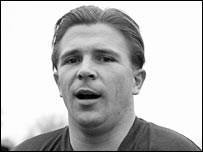
Showing posts with label Legend. Show all posts

Saturday, November 18, 2006

Heartfelt gratitude, admiration and respect for the late Ferenc Puskas.

Ferenc Puskas Biro died on November 17 due to a long illness he had been suffering. He was 79 years old. Puskas was born in Budapest on April 2 1927 and played for Real Madrid between 1958 and 1967. He is considered to be the best goal scorer of the 20th Century and one of the best players in football history. Puskas won five Spanish Leagues and three European Cups with Real Madrid. The whole Madridista family grieves the loss of one of its greatest legends.


Official Announcement from Real Madrid
Heartfelt gratitude, admiration and respect for the late Ferenc Puskas

Real Madrid wish to express their deepest grief for the passing away of Ferenc Puskas, legendary player of our Club from 1958 to 1967 and to convey their heartfelt gratitude, admiration and respect for one of the biggest stars in the history of the Madridista pantheon.

In the minds of all Madridista fans, the name of Puskas is linked to the biggest domestic and international successes of Real Madrid and most specifically to the European Cup. An entire generation grew up watching the feats of this brilliant Hungarian player, his sole mention reminiscent of their younger years, trading picture cards, black and white TV sets and sepia-toned photography.

On this painful hour, Real Madrid wish to thank a person and player that gave everything for his Club, and express their admiration for his footballing talent and their respect for a phenomenal human being.


Ferguson remembers 'special' Puskas

Sir Alex Ferguson hailed Ferenc Puskas as "a very special player" following news of the legendary Hungarian's death.

The Manchester United manager met Puskas on more than one occasion and was in the crowd when the former Real Madrid star enjoyed one of the most memorable nights of his career. However, while Ferguson will never forget Puskas' four-goal salvo in the 1960 European Cup final win over Eintracht Frankfurt at Hampden Park, a visit to Ibrox three years later also sticks in the mind.

"I was lucky to see Puskas play quite a few times," said Ferguson. "I have many memories of him. I was at the European Cup final in 1960 but I also saw him score the only goal against Rangers at Ibrox, before he got a hat-trick against them when Real scored six in the second leg."

He added: "In his day he was a special player without question, part of that great period for Hungarian football. How they did not win the World Cup in 1954 is beyond me.

"It is sad news. But when a great player like that passes, you can at least reflect on what a great player he was and the great games he played in."

Puskas was part of the 'Magical Magyars' team that became the first Continental side to beat England at Wembley in 1953, a game Ferguson remembers well.

"There was one point when Puskas cut back inside Billy Wright and took him so far out of the game he had to pay three and six to get back into the ground," he laughed.

"He was a marvellous player in a fantastic team. The following month they went to Scotland and beat them as well.

"The European Cup final at Hampden was amazing. He scored four then but he also got three against Benfica in 1962 when Real Madrid lost.

"Can you imagine scoring a hat-trick in a European Cup final and not winning? That is amazing."


Wenger - Puskas was a sensational player

Arsène Wenger has paid tribute to Ferenc Puskas, the Hungary and Real Madrid legend who died at the age of 79 on Friday morning.

Puskas led the revered Hungary team of the early 1950s before inspiring Real Madrid to a string of domestic and European trophies. He scored 512 goals in 528 games for the Spanish giants and netted 83 times in 84 international appearances.

"As a player he was absolutely fantastic not only from the very little I saw, but also what people told me," said Wenger at his pre-match press conference on Friday.

"I saw a little bit of him at Real Madrid because I had a black and white television. But people told me he was amazing. The fact that he won what he won and he got the respect from everybody as well tells you a lot.

"It tells you a little bit of what life was like at that time. He was one of the two or three best players in the world and at the end of his life he had nothing to survive on.

"People had to put money together so he could be treated in another way because he had Alzheimer's and that's what life was at that time - greatness and difficult times as well.

"As a coach he had a difficult career, he was ill but we have great respect for him because he was a sensational player."

Puskas, who scored four times in Madrid's famous 7-3 win against Eintracht Frankfurt in the 1960 European Cup Final, was part of the Mighty Magyars side which became the first overseas team to beat England on home soil in 1953.

He was voted the 20th century's sixth best player by the International Federation for Football History and Statistics. Wenger believes Puskas would have been a giant of the game regardless of the era he played in.

"I don't like to compare players from different times but I always say the best from their generation would have adapted and would still be the best today.

"It's difficult to ask if he was better than Zidane but I saw a guy today saying he had the brain of Zidane, the determination of Rooney and the skill of some Arsenal players, so he must have been a hell of a player."

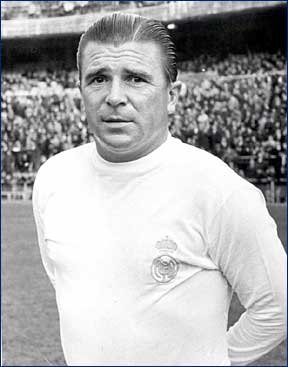
Former Real Madrid and Hungarian soccer great Ferenc Puskas dead at age 79.

Ferenc Puskas, who captained the great Hungarian national team of the 1950s and won three European Cup titles with Real Madrid, died Friday at age 79.

Considered one of the all-time greats of world soccer, Puskas died at 7 a.m. local time at the Kutvolgyi hospital in Budapest due to respiratory and circulatory failure, family spokesman Gyorgy Szollosy said.

Puskas had been hospitalized for six years with Alzheimer's disease and was being treated for a fever and pneumonia in recent days. He had been in intensive care since September.

Nicknamed the "Galloping Major" in reference to his army rank, Puskas scored 84 goals in 85 matches for Hungary between 1945 and 1956. The stocky, left-footed forward guided the "Magical Magyars" to an Olympic gold medal in 1952 and to the final of the 1954 World Cup, where they lost to West Germany.

Puskas also spent part of 1968 in Canada, coaching the Vancouver Royals of the North American Soccer League.

One night in Toronto that summer, he teamed with another Hungarian soccer great, Ladislav Kubala in a friendly soccer match. Kubala was coach of the Toronto Falcons at the time.

Puskas starred in two of the most famous games in European soccer history - scoring twice in Hungary's stunning 6-3 upset over England at Wembley Stadium in 1953, and scoring four goals in Real Madrid's 7-3 win over Eintracht Frankfurt in the 1960 European Cup final.

"There is not one Hungarian who would be left untouched by the death of Ferenc Puskas," Hungarian Prime Minister Ferenc Gyurcsany said in a statement. "The 20th century's most well-known Hungarian has died. ... The nation's striker is gone."

To millions of fans in Hungary, Puskas was known simply as "Ocsi" or "little brother."

"Of all of us, he was the best," the late Nandor Hidegkuti, a teammate on the legendary Hungarian national side, said at Puskas' 70th birthday party in 1997. "He had a seventh sense for soccer - if there were 1,000 solutions, he'd pick the 1001st."

In 1999, Puskas was voted the sixth-best player of the 20th century, behind Pele, Johan Cruyff, Franz Beckenbauer, Alfredo Di Stefano and Diego Maradona.

According to the German-based International Federation of Football History and Statistics, Puskas was the world's third-most successful national championship player.

Studying records going back to 1888, the Federation listed the top scorers in national championships and Puskas scored 511 goals in 533 games between 1943 and 1966, behind only Pele and Josef Bican.

Puskas was born Ferenc Purczeld on April 2, 1927, in Kispest, a working-class district in Budapest.

He was 10 when his father, himself a central defender for Kispest, changed the family name to Puskas.

"When I was a kid I liked to kick rocks in the street, always making sure I'd hit a tree or another rock. It was murder on my shoes, but great training," Puskas wrote in an article for London's Daily Mirror after Hungary's memorable victory over England.

Puskas made his professional debut with Kispest on Dec. 6, 1943, at the age of 16.

Although Hungary won gold at the 1952 Helsinki Olympics, its greatest moment came on Nov. 23, 1953, when the "Golden Team" beat England for the host nation's first home defeat by a non-British opponent.

"It was like racehorses against carthorses," England winger Tom Finney said. "They were the greatest national side I played against, a wonderful team to watch with tactics we'd never seen before."

Puskas said: "We should have won by more, but we had never played against the Brits before."

When the teams met again in Budapest in 1954, Puskas scored two more goals as Hungary won 7-1.

Hungary was heavily favoured to win the 1954 World Cup in Switzerland. But Puskas wasn't fully fit and the Germans, led by Fritz Walter, won 3-2, despite trailing 2-0 at halftime.

"We had an off day," Puskas, never known for using too many words, remarked years later.

Several Italian club teams tried to lure Puskas in 1947, but the offer was turned down.

"I wouldn't leave my parents, my friends, or Kispest for anything," he said at the time.

Under communism, Puskas was given the rank of major when the Kispest team was renamed Honved (Soldier) and, formally, attached to the Hungarian army.

But Puskas was never in the army as such and when given a gun to shoot, "I managed to hit the air," he said.

The national team was on tour at the time of Hungary's 1956 revolution and Puskas chose not to return when the uprising was crushed by the Soviets.

He defected to Spain and played for Real Madrid from 1958-66, endearing himself to fans who called him "Pancho." Although he was past 30, overweight and thought to be past his prime, he helped the club win five straight Spanish league titles during that time.

Puskas was part of the squad which won the European Cup in 1959, 1960 and 1966. He missed the 1959 and 1966 finals through injury but collected winners' medals after playing in earlier rounds.

Puskas was the Spanish league's top scorer four times, netting 512 goals in 528 games for Madrid.

"His playing style revolutionized Spanish sport," wrote Spanish sports commentator Andres Merce Varela. Real Madrid teammate and fellow all-time great Alfredo di Stefano simply called him a "super talent."

"The Real Madrid family feels deep sadness over the passing of one of its greatest legends," the team said in a statement Friday, adding that Puskas "is considered the best goal-scorer of the 20th century and one of the best soccer players in history."

Puskas took Spanish citizenship and played for the Spain national side four times, including at the 1962 World Cup. He retired in 1967 at age 39.

Back in Hungary, Puskas was charged with treason in absentia and stripped of his military rank. It was restored after the collapse of communism and he was even promoted to colonel in 1992, a year after he resettled in Hungary.

Puskas went into coaching and won two Greek championships with Panathinaikos, which he also guided to the final of the 1971 European Cup. He also had coaching spells at Real Murcia and AEK Athens, among others, and a four-game stint as Hungary coach in 1993.

The Budapest stadium was renamed Ferenc Puskas Stadion in 2002.

Puskas is survived by his wife, Erzsebet, and a daughter, Aniko. Funeral arrangements were not immediately announced.

Friday, November 17, 2006

Real Madrid and Hungary legend Puskas 'critical'.

Real Madrid great Ferenc Puskas is in critical condition in a Budapest hospital, according to media reports.

Sport daily Nemzeti Spor said the 79-year-old, who has been in intensive care for two months, is suffering from a fever and pneumonia.

Puskas has been confined to hospital for six years with Alzheimer's disease.

He led Hungary's Golden Team of the early 1950s, before taking Spanish citizenship and becoming part of Real Madrid's all-conquering team.

Puskas scored a remarkable 83 goals in 84 matches for Hungary between 1945 to 1956, many of them with his hammer of a left-foot.

After leading Hungary to the 1952 Olympic Gold medal, he was part of the Mighty Magyars who became the first overseas team to beat England on home soil in 1953, scoring twice in the 5-3 win at Wembley.

Hungary then rolled England over 7-1 in Budapest and were consequently installed as favourites for the 1954 World Cup in Switzerland.

But injury to Puskas severely hampered the Magyars and they lost in the final to Germany.

Puskas joined Real Madrid and, along with Alfredo di Stefano, was the inspiration behind a string of domestic and European titles.

He scored four goals in Real's 7-3 win over Eintracht Frankfurt in a remarkable final at Hampden Park in 1960, and won the European Cup three times with Madrid side.

In all, he scored 512 goals for Real in 528 matches and in 1962 he took out Spanish citizenship in time to play for his adopted country in the 1962 World Cup.